by Romano De Caprio ’24
Gerd Schreiner is a local politician for Rhineland-Palatinate, and he is currently fighting to make big changes. Throughout the month of March, he was gracious enough to let me experience the beauty of German local politics.
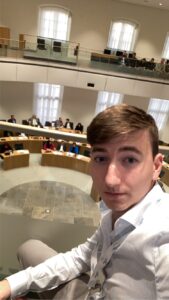 Mr. Schreiner is a member of the “Christlich Demokratische Union Deutschlands“ (CDU) in Rhineland-Palatinate, which is a successful Christian-democratic, conservative, and economically liberal party in Germany. He is the head of the ‘Klimaschutzpolitik’ for his faction, which means he has input in every form of climate protection-based policy in Rhineland-Palatinate. When I first arrived in Mainz at the end of March, I had no idea what to expect. All that I wanted to get out of this internship was to be able to see how the inner workings of German politics function. It did not take long for me to see Mr. Schreiner meet with numerous Mainz Citizens daily and work with them to better his beautiful city. On the very first night of my internship, Mr. Schreiner said to me “Come to my event tonight, it will give you a true insight into the way politics work here.”
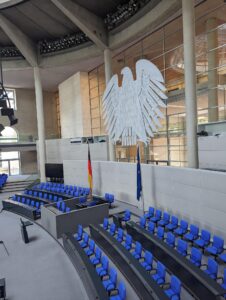
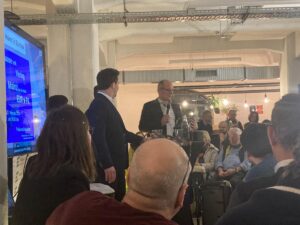 The event was called a podium discussion, which Mr. Schreiner was the moderator of. I was unaware until the beginning of the event that the two men discussing at the podium would be Nino Haase (non-party) and Christian Viering (Die Grünen), the two men running for Mayor and at the time in a run-off race. Although it was apparent that they were competing against each other, their civility and respect for one another were incredible. Even though I might not be German it was evident to me that both candidates had the goal to make Rhineland-Palatinate better for all. The event itself was delightful and truly set the tone for the rest of my time in Mainz. The next day I was able to sit in on the CDU-Fraktion’s group meeting where they discussed what they would say at the next Parliament meeting, and then I was able to witness them in action hours later as the Bundestag met. My everyday life in Mainz was simply enhancing and unimaginable, every day was so different from the last.
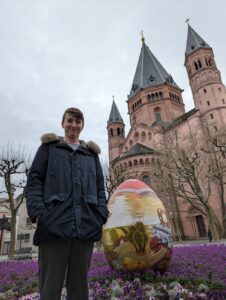 One day Mr. Schreiner took me to the city of Sinzig to meet with businessmen and discuss how to avoid another possible flood. After that meeting, Mr. Schreiner drove me around the town so that I could see the impacts of the last flood and he informed me of all the tragedies that occurred in a certain area. The next day we met with two architects from Berlin and Mr. Schreiner gave them a private tour of Dom St. Johannis, the older delicate Cathedral in Mainz. I was very lucky to see the insides of this beautiful historic Cathedral for myself, and I could not believe how spooky the hidden crypt aspect was.
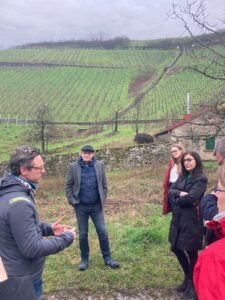 However, my absolute favorite experience of my internship did not even take place in Mainz. On a Friday in late March, Mr. Schreiner, his team, and I drove to a town called Würzburg in Bavaria. There we learned about the new innovative ways that people are becoming more carbon-friendly and what adaptations ‘Wine Mountains’ have made in the past few years. Both topics were insightful to learn about and everyone was extremely nice. It was tricky to understand the Germans from Bavaria because they have a very unique dialect, but I had an amazing time.
Overall, working for Mr. Schreiner was simply a pleasure, I was genuinely excited to go to his office every day. I did not have the most rigorous amount of daily work as my big project was to write an article on the differences in carbon neutrality in sports stadiums between the US and Germany, that will appear in a book published by Mr. Schreiner. This article took up the majority of my time in Mainz, and along the journey of writing it, Mr. Schreiner was extremely kind in helping me. He taught me a lot about the German grammar errors I was making but more importantly, this project taught me how to take it upon myself to research a topic and gain expertise on it all on my own. I am very grateful Mr. Schreiner took me on to be his “Praktikant” and it has been a memory of a lifetime for me!
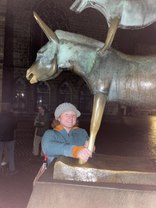 pumped storage power plant and the VW EV-production facility, talking to renewable energy specialist, etc., spanning over three big cities in Germany: Berlin, Dresden and last but certainly not least Bremen!
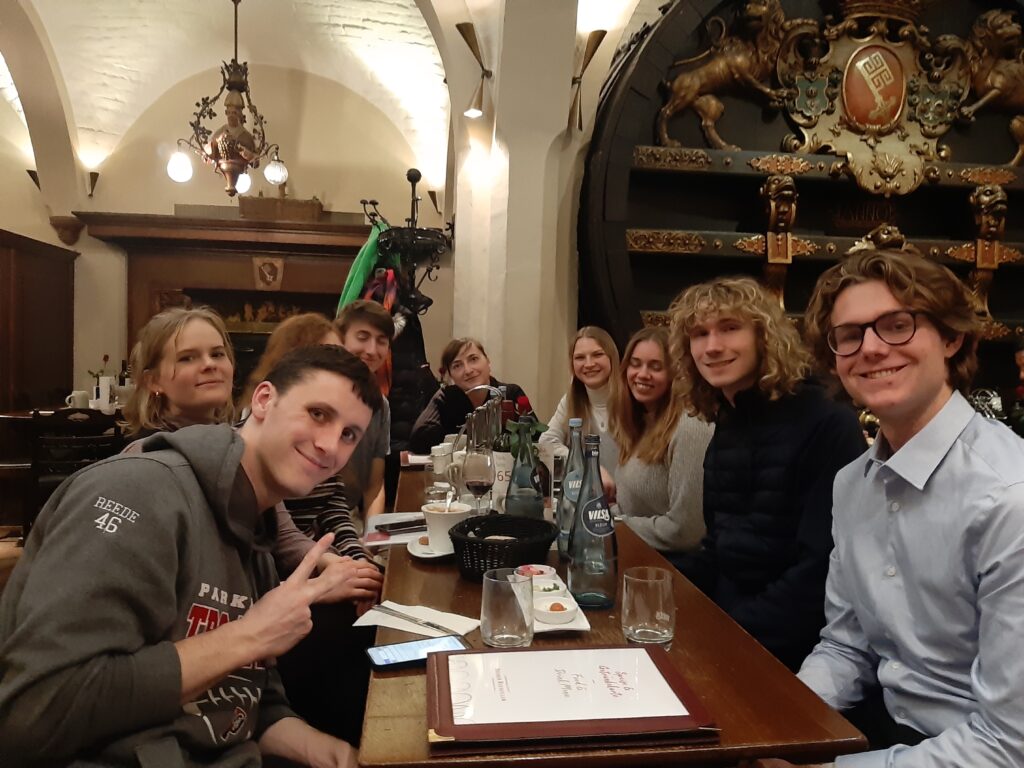
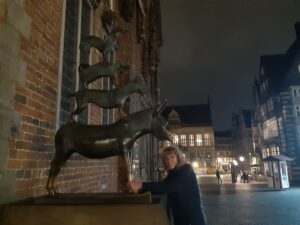
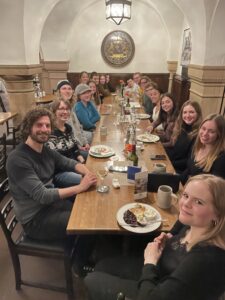 wonderful group and dining together at the famous “Ratskeller” in the city center, followed by a very entertaining Night Guardian tour of the city.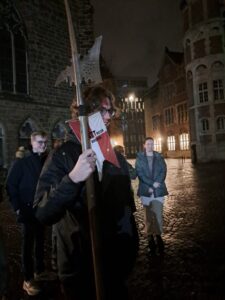
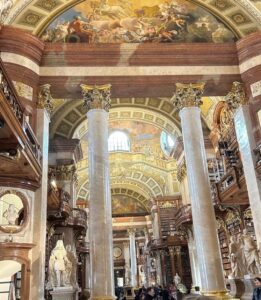
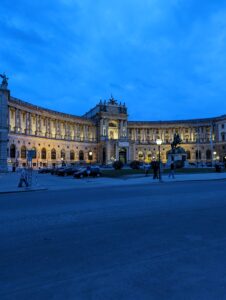
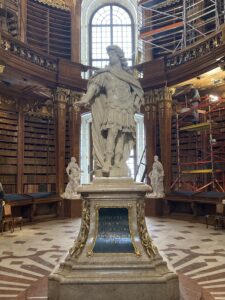 “My favorite sight was also the Austrian National Library. I found the books very interesting and the architecture was amazing. This is a statue of the emperor Charles VI and he was symbolized as the sun. There were red sun flames on the floor and which I found very intriguing.” – Romano De Caprio ’24