Freiburg Language Course

September 3
Homesickness, sleeplessness, thankfulness, untrammeledness. At the spatial separation from the familiar; from the temporal separation from the familiar; for a safe, timely, and uneventful arrival; at the novelty of experience.  Then two more days in Freiburg. Language course started. Hunger and thirst, but not yet for that.

September 4
Day-trip to Alsace, in contrast to prior Freiburg. Went to Hochkönigsburg, Riquewihr, and Kaysersberg. Spoke in English, thoughtlessly, conversing with Americans, Australians, English, and Irish. In French, tentatively, ordering a snack at Hochkönigsburg and lunch at Riquewihr. In German, thoughtfully, communicating with non-Americans, non-Australians, non-English, and non-Irish. In Spanish, livelily, chatting with a Spaniard. Pleasant remembrance of bicycling up to Hochkönigsburg four years ago on the tandem with Wolfgang; vivid perception of the Riquewihr alleys, architecture, and colors, plus that perfect slice of peach pie; underwhelming impression of Kaysersberg. Worth it.

September 5
Went for a run on my first appointmentless morning around a nearby lake with a perimeter of, at a jog, about eight minutes. Afternoon sojourn to the Schlossberg; lots of steps; nice views of Freiburg before returning. Took away a filling yet inexpensive Turkish döner to eat beside the cathedral. Finally both well-nourished and well-hydrated.

September 6-10
Feeling occasionally with respect to the German language like an adolescent Andre Agassi with respect to tennis, but sharing none of this attitude for the sport itself.

September 11
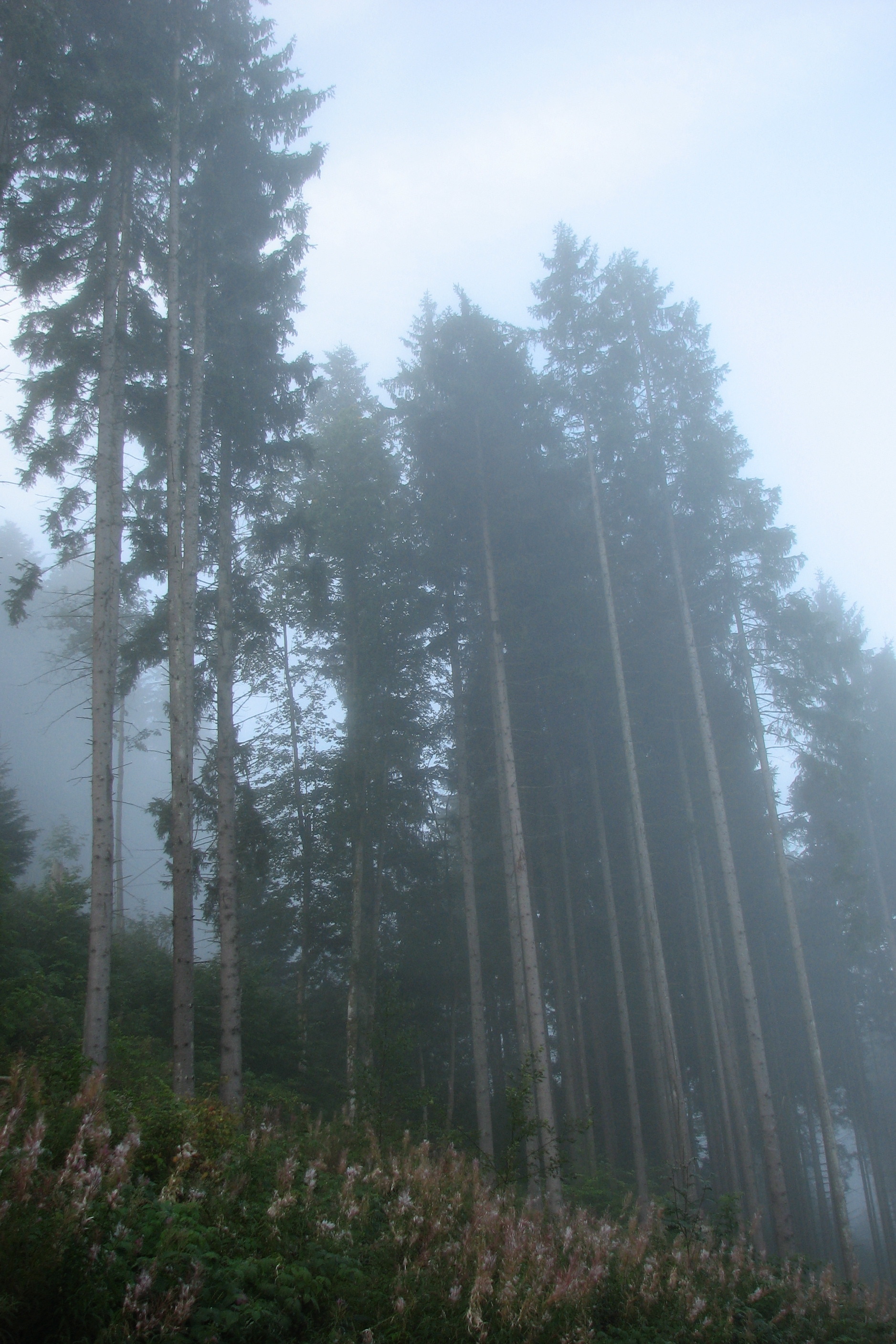
Day-trip to the Black Forest, near St. Peter’s. Left the freshness of the first time unmatched, but at least being there amidst the trees was a nice sensation to revisit.

September 12
Rapturous. Woke up at 5:30 to leave the Freiburg train station 70 minutes later. Arrived to a sea of fog in Titisee. Some glorious false starts finding the path to the top of the mountain Hochfirst. Eventually got there with directions from a Frenchman, his dog, and a couple of German joggers, to enjoy a view that was as calming as a remoteness dotted only occasionally with Nordic walkers. Descended back into town with plans to return to Freiburg prior to finding a €16,95 lunch buffet; felt sufficiently hungry to make my discovery worthwhile. Made my way inside and was greeted successively by the head waiter, noodles, rice, and vegetables of the season. Opting for an outside table with my plate, received notice from said waiter, who, realizing either that this rustic tourist, in not having selected any of the extravagant French appetizers, was somewhat incongruous, or merely that this ravished alpine hiker was just as famished, inquired whether to consider the entire buffet in the price, or that plate only, in which case he would make a special offer. Cheerfully accepted this and the iced tea with fruit from the forest that he complied to bring, which accompanied my favorite meal of the trip to that point. Some almond pastries from the Titisee train station complied to accompany me back to Freiburg. Pensive remembrance of descending the road cutting visibly through the trees to Titisee then.

September 13-18
Still deepening in esotericism, familiarity, restlessness in Freiburg.

September 19
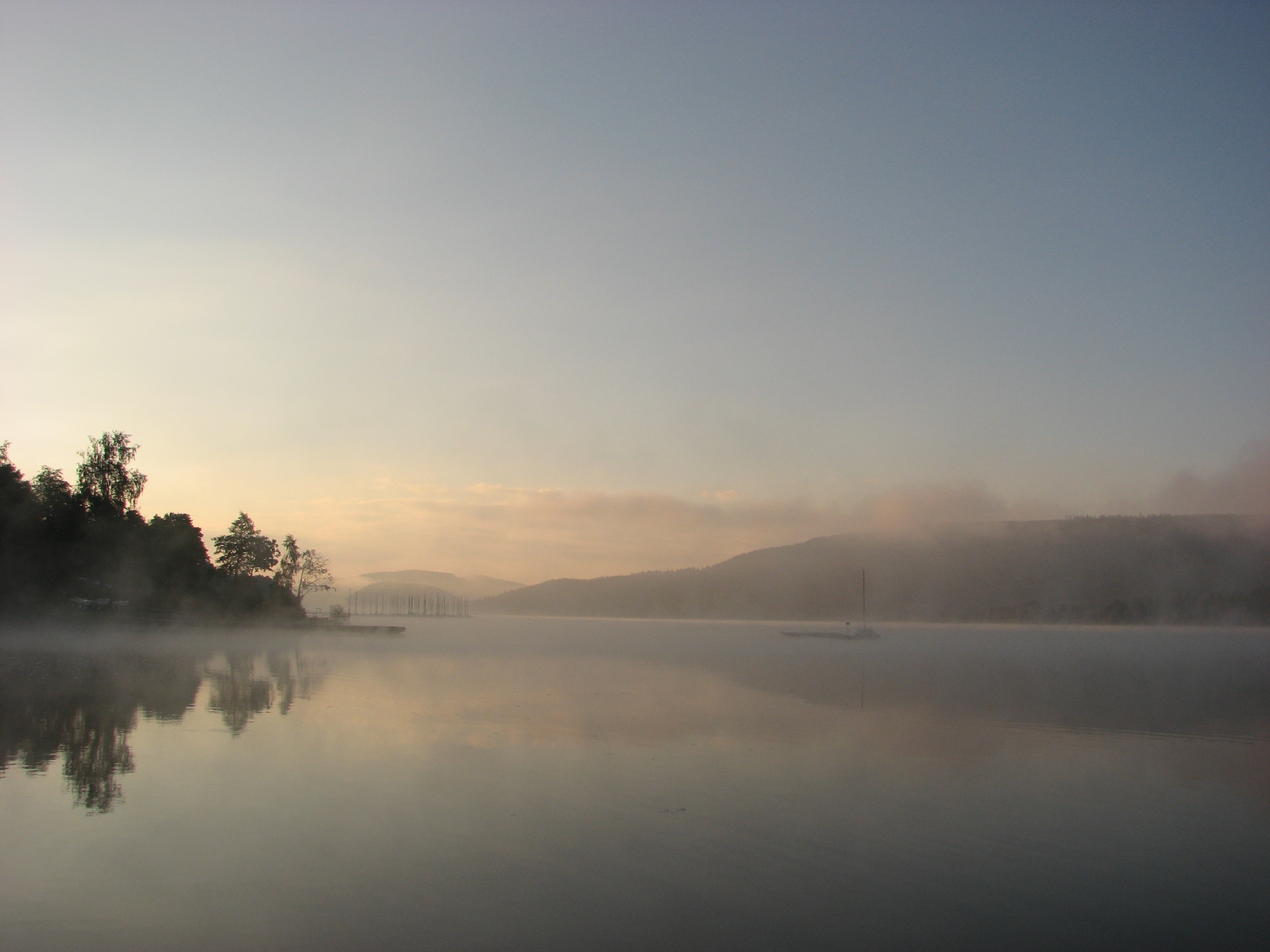
Revisited the schedule of that seven days hence to visit, for the first time, the Schluchsee. The additional half hour riding the train to Aha turned out not to detract from a land-and-seascape that was still more impressive than its predecessor. Departed from the train to an immediate dawn. Jogged, lingered, walked from Aha along the Schluchsee to the town of the same name. Let us call it the best day so far.

September 20-23
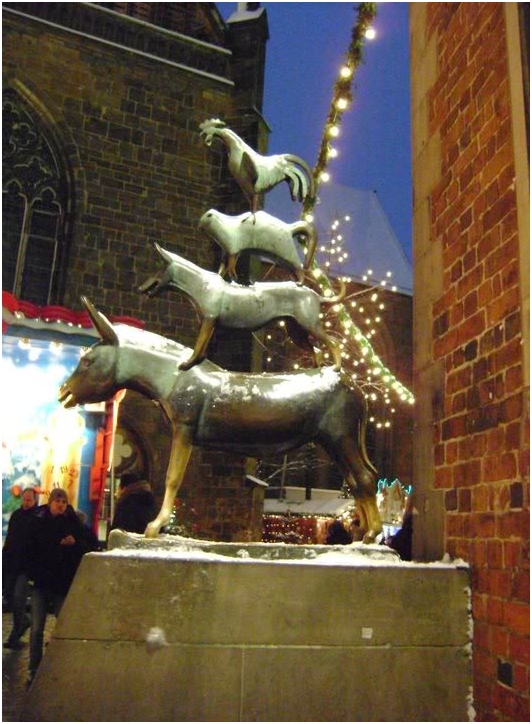
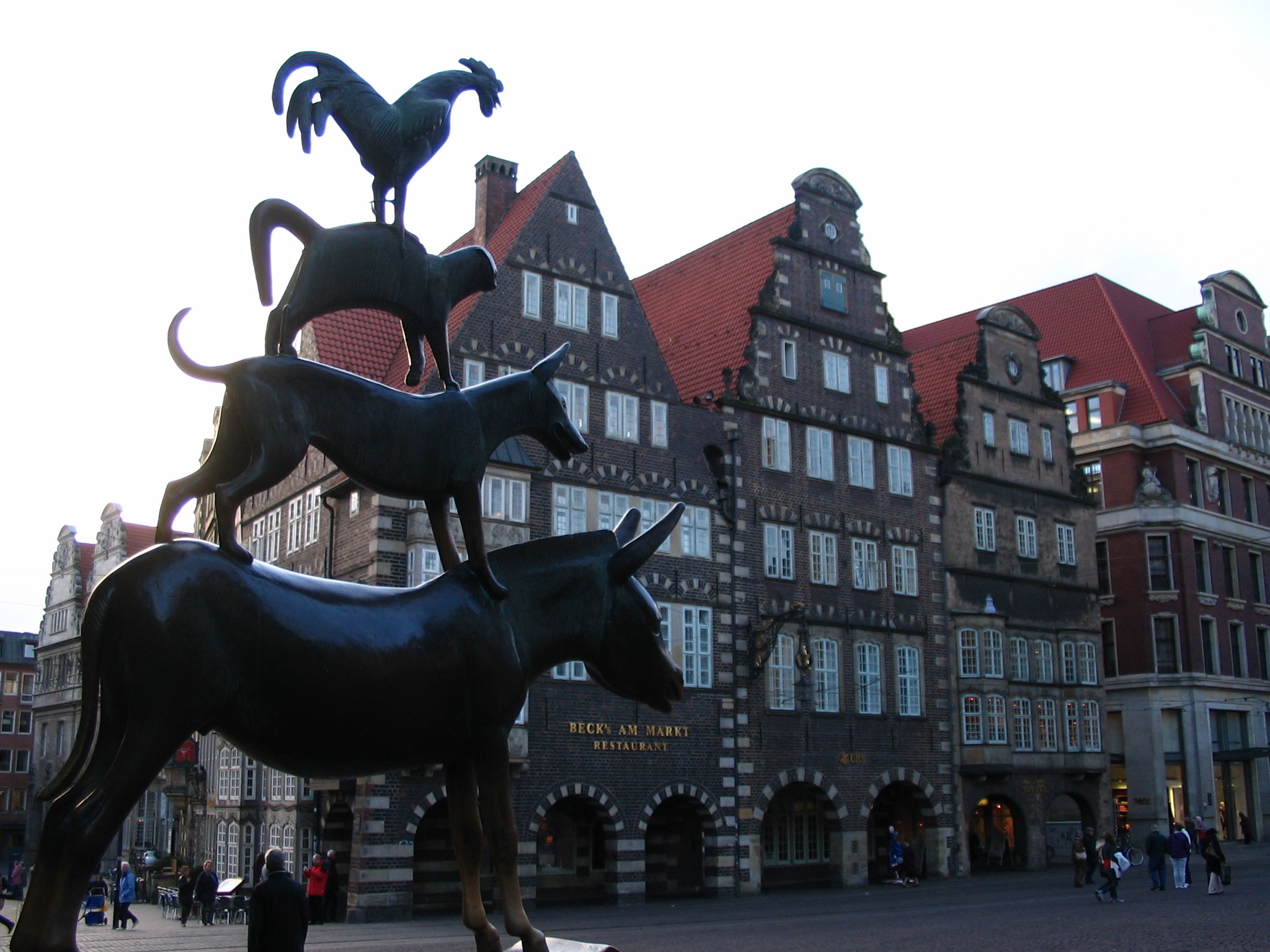
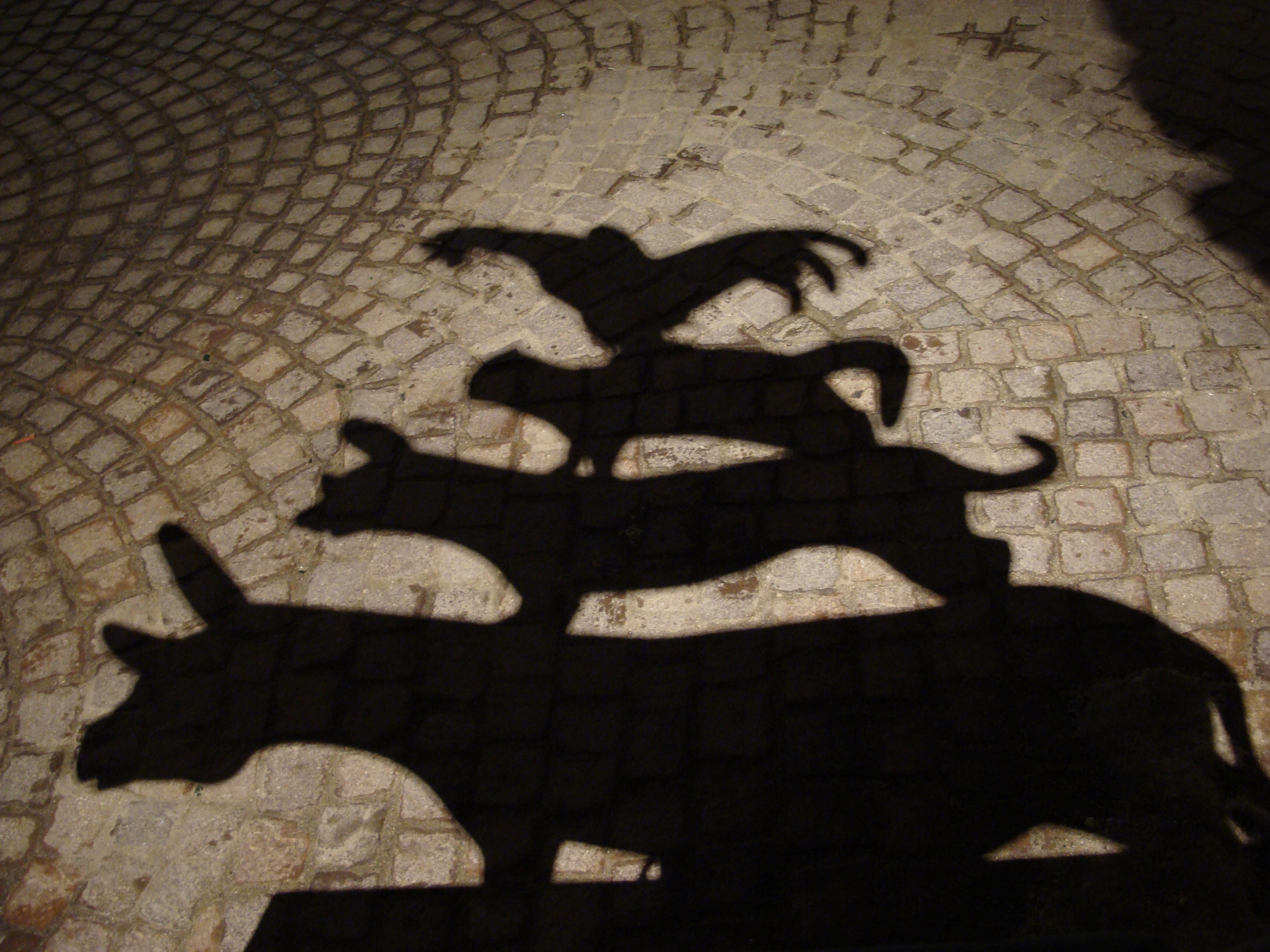
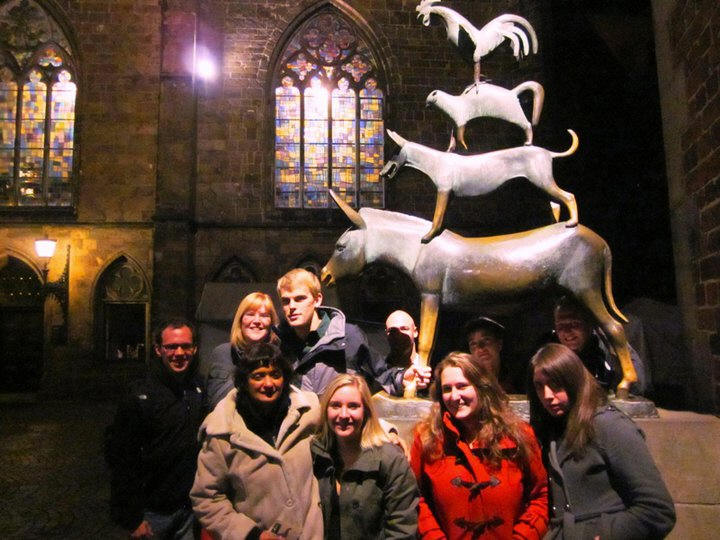
I was worried that everyday communication in German would, if only marginally, lessen my adeptness in English, as was unequivocally true after a month here two years ago. Contrary to this expectation, but understandably so, as I did next to nothing with English during that visit, and during this one had still been primarily reading in it, not speaking English now had refined it to reflect the input it receives, rather than deteriorated it to a lesser degree than previously (a refinement more noticeable at the time, as I was still reading Proust; at least this is written a month later). And in terms of written comprehension, as the bald eagle goes highest and fastest, the flight of the black eagle still skids, so to speak, and although it outstrips almost all others, the closest behind being the rooster and the wolf, eyeing each other carefully, the secondbest eagle cannot keep pace with the nonchalant stride of the bull.
What the World Cup Means

by Andrew Shuman ’11

As with many Americans, indeed, many more than Europeans may expect, I’ve played soccer nearly my entire life – since I was five, to be exact. As such, I’ve been a fan of the game for a very long time, starting with 2002 World Cup in Korea and Japan, when I got up in the wee hours of the morning to watch the final, where the Germans and their immortal keeper, Oliver Kahn, previously next to unbeatable in the tournament, lost to Brazil and Ronaldo. Arguably, those two players, Ronaldo and Kahn, are the best striker and goalkeeper of all time, respectively. That epic matchup, which ended 2-0 for Brazil, one of the goals coming following Kahn’s only error of the tournament, got me hooked on the international game. From the Champions League, in which Europe’s top club teams compete, to the 2006 World Cup and the 2008 European Championships, I don’t think I’ve missed a televised game if I could help it.

Being here in Germany for the 2010 World Cup and having just seen the die Mannschaft (literally, ‘the team’) crush archrivals England at a public viewing yesterday, though, has given me a real appreciation for the meaning of international football here in Europe. The World Cup and the Euro are far more than simple spectacles of sport; the national teams embody the histories and identities of entire nations.

Soccer is an inextricable part of Germany’s past, and, unlike the World Cup history of the United States, Germany’s history of participation in the tournament is riddled with momentous victories and defeats that came at defining moments in the history of the nation itself. Those moments have been indelibly etched upon the national conscience of the German people and that history gives added meaning to classic matchups like Germany vs. England. It’s obvious to everyone, of course, that two world wars fought between the two nations, as much as it is politically correct not to acknowledge it, play a role. However, the fact that England’s only World Cup victory in 1966 came against West Germany in the final at Wembley Stadium in London and the fact that the English have caved under pressure and lost to the Germans in two penalty shootouts on the international stage in the 90’s provide just as much of a backdrop. The looming quarterfinal matchup with Argentina, for instance, is far more than a game between, arguably, the two best teams in the tournament so far; it’s a rematch of the quarterfinal of the 06 World Cup, where Jens Lehmann saved 2 Argentine penalty kicks to put the Germans through, a rematch of the 1990 World Cup Final, where an Andreas Brehme penalty give the Germans their 3rd World Cup victory against the Argentineans, and a rematch of the 1986 final, where the greats of the German game, names like Lothar Matthäus, Karl Heinz Rummenigge, and Rudi Völler lost out to Diego Maradona and Argentina. Almost every matchup has that historical dimension and undertone, and, if I had to pick one thing only, I’d say that’s the biggest missing element from the World Cup experience from an American viewpoint. Hopefully, one day we can develop a storied World Cup history, to the point where a USA v. England matchup isn’t just presented as a ‘second American Revolution’, but as round two, or even three, of a matchup that has already delivered truly classic World Cup games.

Moreover, football has, at times, taken on a far greater role than that of a mere sport in German history. The German’s first World Cup victory in 1954, during the depression and disillusionment of the post WWII years, inspired and helped to heal a downtrodden nation, creating, to some extent, a new, positive national identity free from the ghosts of the Nazis. In German, the 1954 victory is known as “Das Wunder von Bern”- The Miracle of Bern, since the underdog German team beat the Hungarians in the final, a team considered nearly immortal and unbeatable. Germany’s third World Cup victory in 1990 came just as West and East Germany, so long divided, were coming together at long last as a reunified Germany, and die Mannschaft’s win over Argentina crowned that triumphant moment in German history.

This World Cup, regardless of whether the Germans can win the 4th star or not, I think the very makeup and playing style of the German team speaks volumes about German society and it’s development over the last few decades. A cursory glance at the German roster reveals that many of the players don’t exactly have names that seem ‘typically Germany’, and it is indeed true that the team is made up of many players from a diverse immigrant background. Lukas Podolski and Miro Klose, for instance, are of Polish heritage, as their names betray. Sami Khedira is of Tunisian extraction. Mesut Ozil is of Turkish lineage, Cacau is a nationalized Brazilian, and Jerome Boateng is half German, half Ghanaian. Ignorantly, I think, many people jibe that this German team isn’t really German at all. Sure it is. The jingoist assumption that to be ‘German’ means having blonde hair and blue eyes and having a last name like Schweinsteiger or Mertesacker no longer has a place in modern German society, and, for their part, I think the Germans are rightfully proud of the diversity and tolerance the national team reflects in their society.  What’s wrong with a new German national identity, one that stresses the nation’s willingness to accept immigrants and people from all sorts of different backgrounds and consider them just as much a part of Germany as any others? Nothing.  The new, ethnically diverse identity of the national team has, it seems, coincided with a radical change in the teams of style of play. Gone are the days of the stereotypically dour, efficient, and stout playing style of the German teams of the 70’s, 80’s, and 90’s. The team we’re seeing in the 2010 World Cup is young, vibrant, fast, aggressive, and they combine and move the ball around the field at the speed of light, often times catching opponents flat footed for a counter-attack goal (England, Australia). Thirty years ago, such a free flowing style of play would have been unthinkable from a German side. As the Germans say, these guys have Spielfreude.

The World Cup doesn’t have to, and indeed should not have, the jingoistic undertone of ‘pure’ races of men from different nations having at each other on a grass field to see which race is the best at putting a ball between two posts. The players on the national team represent the people back home- their friends, families, fans, and supporters- as well as the youth football system that made them into the players they are. In that sense, then, if Podolski, Klose, Ozil, Khedira, and Boateng were all born and raised in Germany, how do their ancestries or last names make them any less worthy of representing Germany in the World Cup than Bastian Schweinsteiger or Holger Badstuber? As Americans who live in a society that is defined by its diversity, we should, I think, appreciate how open German society has become.

SCHLAND!!

by Abigail Breckinridge ’11

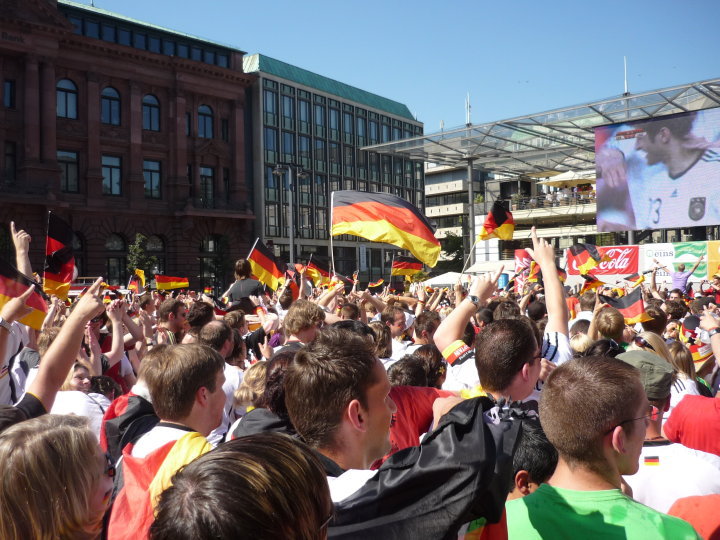
World Cup fever is in full swing again. After yesterday’s trashing of England in a 4-1 victory for Germany, everyone here is feeling a little more, well, German. Our German friends are convinced that the national team is going to earn it’s fourth title, after winning in ’54, ’74 and ’90. (The reason I know this is that there’s a catchy tune that lists the years of the German team’s victories.) There are lots of public viewings, and during halftimes they usually show the huge crowds gathered in Berlin. I’ve watched games with a collection of Americans and Germans, and everyone who is in the country right now seems to be in high spirits. This World Cup, however, has a different feel than the one four years ago, which was held in Germany. I was lucky enough to be have been here, too, and somehow it seemed more in your face (except that I wasn’t quite old enough to really be caught up in the party culture). But this year, as well as in 2006, there is still a massive amount of spirit: face paint and German flags and those annoying little horns that have become the symbol of South African fan fever. In 2006, I usually watched the games with my host family or with my host brother and his friends or my friends from school. This year, it’s all about being together with the other Dickinson kids and the Bremen kids I’ve met here. Now, as then, we don’t miss a game. Everyone knows Germany’s next opponent (Argentina), and everyone has long since learned to hate Italy (because of Germany’s loss in the semi finals of the ’06 world cup). And of course, England is now a laughingstock thanks to the efforts of the “Nationalelf” (national eleven).

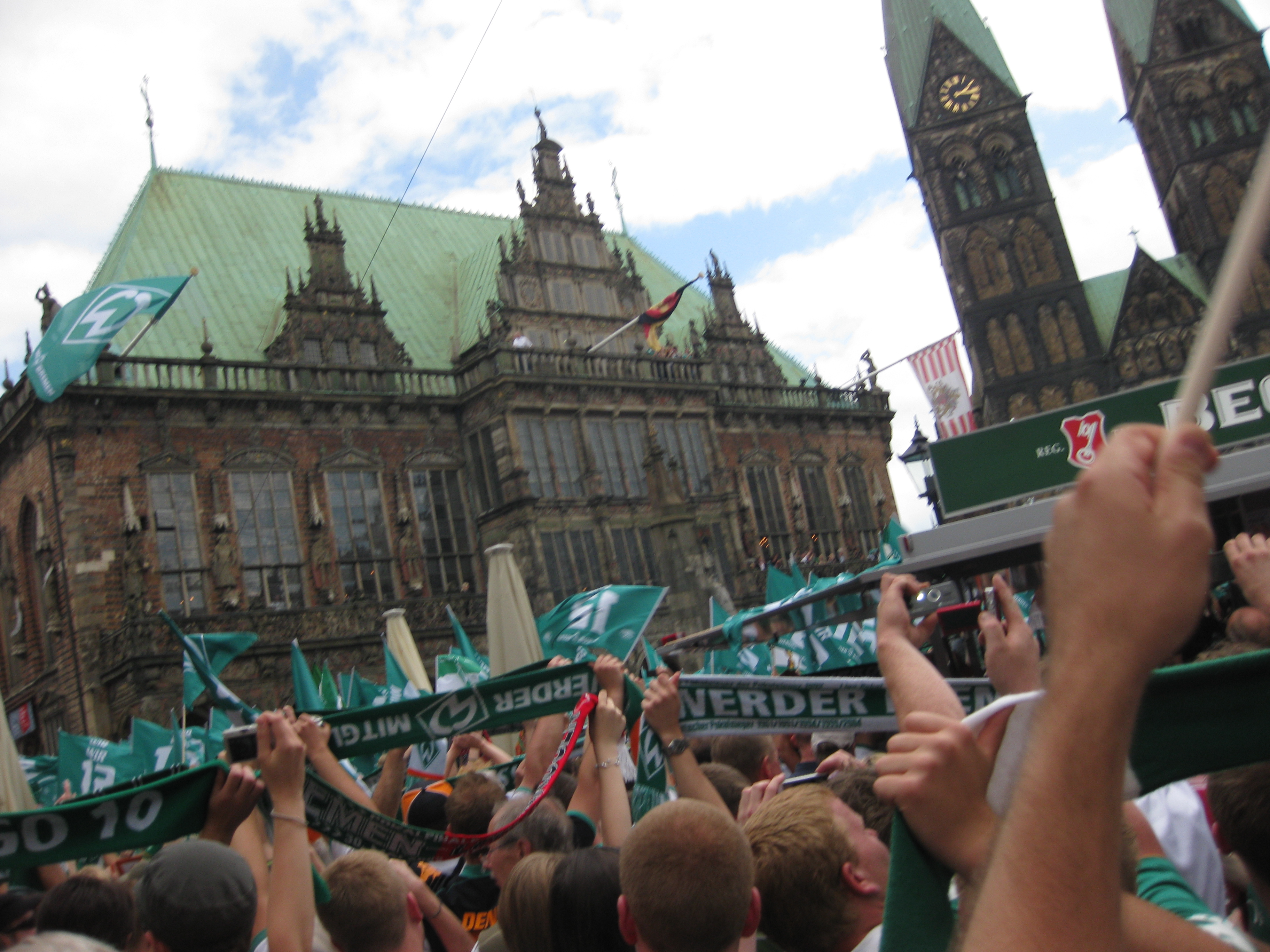
Bremen celebrating the 4:1 win over England at Domshof (Bremen)

In 2006, it was really neat to see Germans being patriotic for the first time since, well, ever. There aren’t as many German flags hanging on front porches as there are American ones in the US, but when it comes to soccer, Germany is a super proud “Fussball-Land”. Even though the games aren’t being played in cities around the country, and rather in the far reaches of South Africa, there is still a definite feeling of soccer mania in the air. It’s great! I even have a German soccer shirt to wear to the games (didn’t really make sense to get a US one… we lost to Ghana… enough said), and sometimes I catch myself saying “we” when referring to the German team. It’s quite an incredible feeling to be caught up in this sports-enthusiastic atmosphere. I think it’s a little more hands on this time around because I’m more on my own and not staying with a family, and I also think that WM 2006 jazzed everyone up and this year is just continuing the celebration. And what a celebration it is. There are loads of songs- some of them general World Cup 2010 South Africa and many, many more German team songs. Everyone dresses up in

Fans at Domshof (Bremen) – Town Hall in the background (by courtesy of Insa Kohler)

full schwarz, rot, gold (black, red, gold) get-up, and the party never stops. Everything here is World Cup-themed, which is certainly no different than four years ago. In fact, I think the only difference is that more Germans were able to go to the games when they were in Germany rather than South Africa, although there is certainly plenty of Team Germany support to be seen when the cameras pan the crowds of this World Cup. So all that’s really left to say is: Schland, oh, Schland, wir sind von dir begeistert – we’re CRAZY ABOUT YOU!!

Inside German Politics

by Andrew Shuman ’11

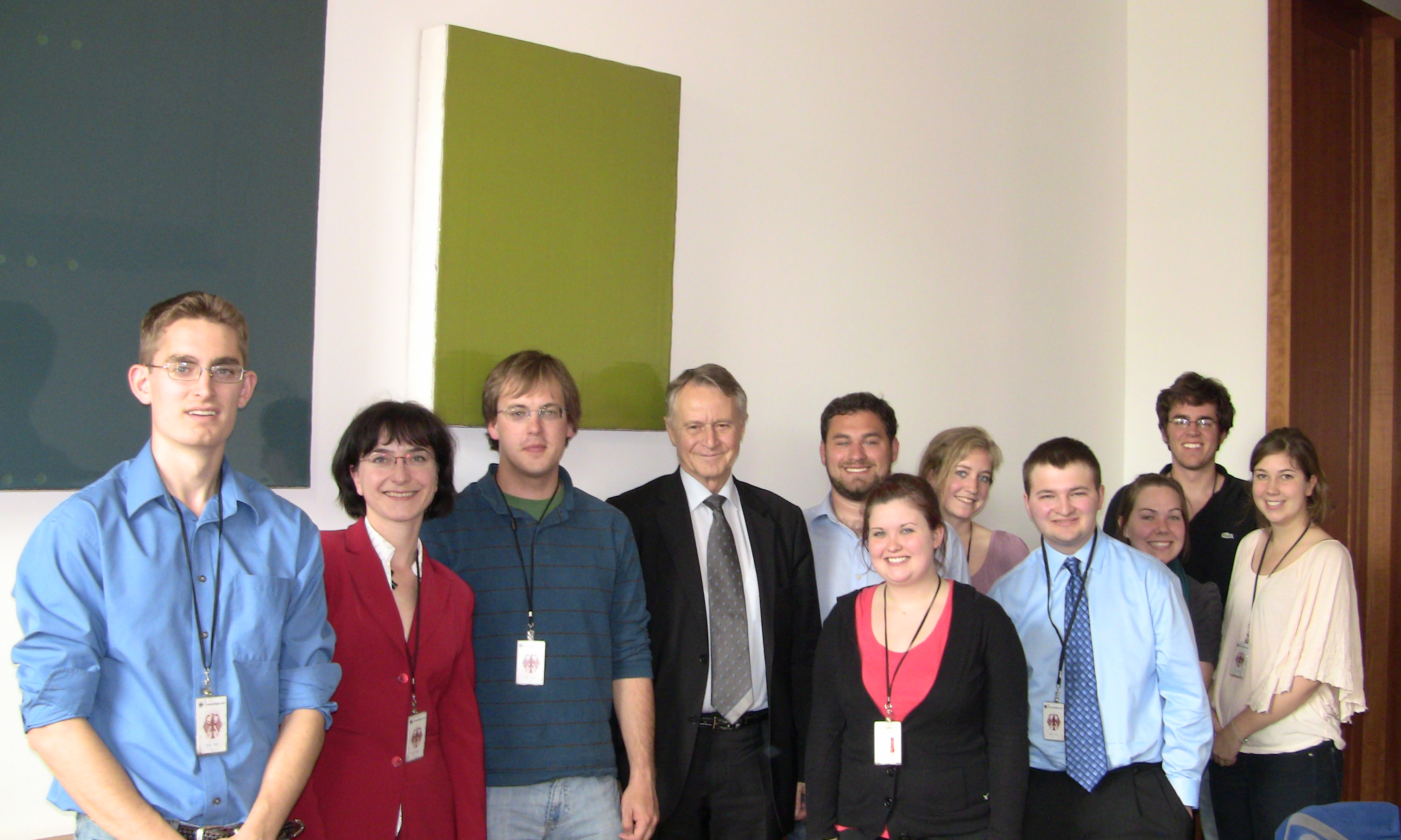
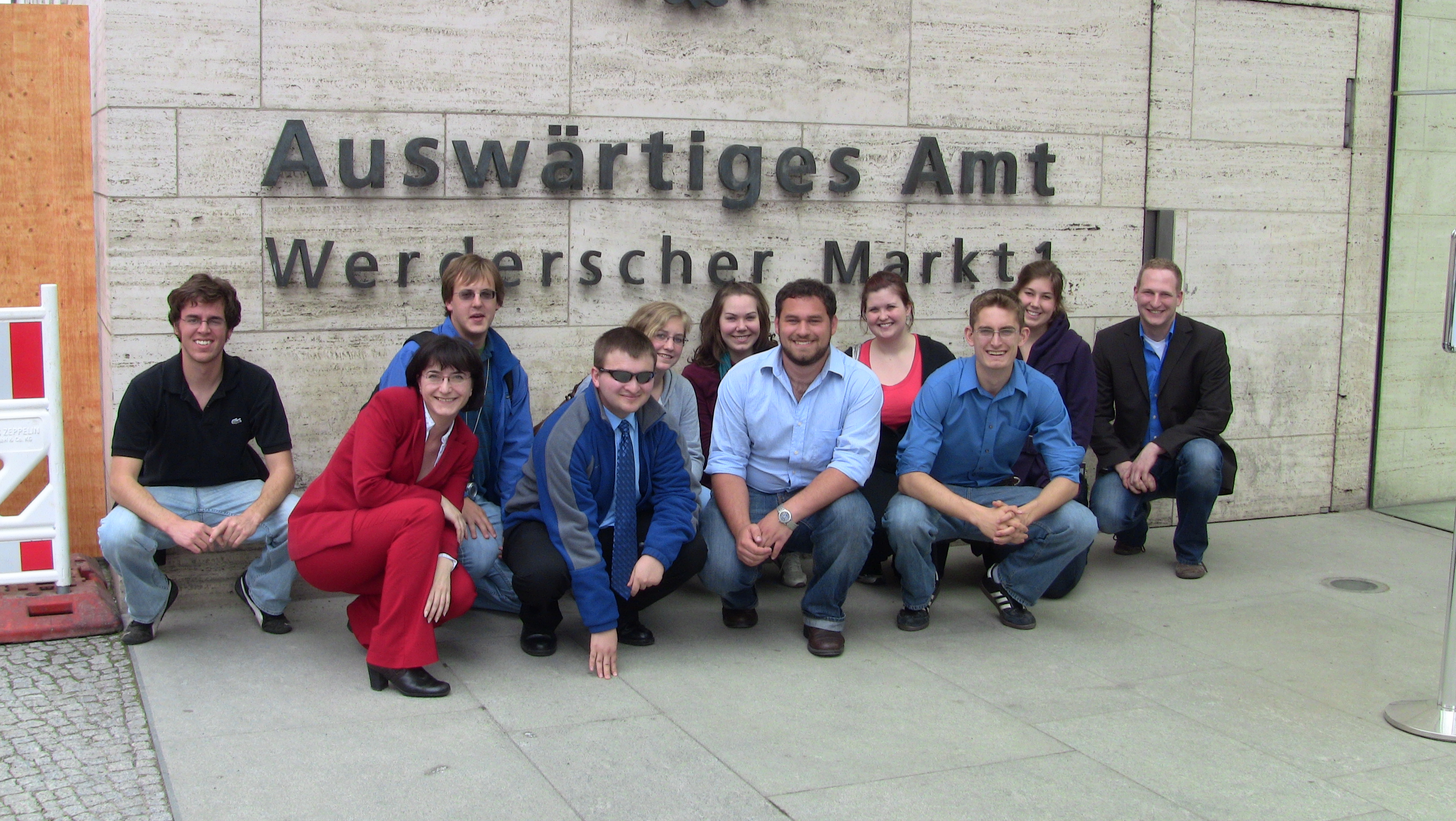
A few weeks ago, the Dickinson in Bremen program took a trip to Germany’s capital, Berlin. Most of the students, myself included, had been there before, so the novelty of tourism was somewhat lessened in degree, but the trip was nevertheless well worth it. The main reasons for that, from my point of view at least, were the two hour long meetings that Janine Ludwig arranged for us with two German politicians, Dr. Carsten Sieling, a representative to the German Parliament from Bremen, and Hans-Ulrich Klose, the coordinator of German-American cooperation. I’d never met with any politician on such an informal, small group basis, much less politicians with an active hand in the handling of a very much current crisis. That European crisis, which began with the massive debt issues in Greece, has seen the Euro plummet in value to about $1.20 and prompted the parliaments of the EU member nations to approve a massive rescue package for the beleaguered Greek government.

Dr. Carsten Sieling (with Dickinso shirt), Dickinson students, and Dr. Ludwig (right)

How Dr. Sieling, who is a member of the SPD political party, which, suffice it to say, means that we don’t exactly see eye to eye on economic issues, articulated the issues the German people and government were facing with regard to the Euro crisis was particularly impressive. As Americans, we’re pretty used to politicians giving short, sound-bite answers that are almost always ideological in nature. For instance, in the midst of the financial and credit crisis in the states, the favorite lines of politicians both right and left revolved around “the greed and excess of Wall Street” and “Wall Street taking down Main Street”. While politically pungent and polarizing, both lines are frustratingly simple, and when one really takes a closer look, they do next to nothing to explain how the US economy really collapsed.

Dr. Sieling, who was actually set to give a speech in the German Parliament later that day on the very issue of the Euro crisis, didn’t say a single thing that made him seem an ideologue.  On the contrary, his explanation of how the crisis developed was thoroughly reasonable, rational, and economically sound (which made me, as an econ major, very happy). He alluded to the fact that Germany’s ability to control labor costs relative to other Euro zone trading partners, namely Greece, Spain, Portugal, and Italy, had enabled the German export economy to thrive with those nations as prime customers. As he noted, Greece’s negative balance of trade as an importing nation had caused the Greek government to become highly indebted, and some of its main creditors, ironically enough, were major German banks. Thus, as he understood only too well, the Germans were stuck between a rock and a hard place; if they let the Greeks fail, they would shoot their own banking system in the foot, and if they approved the bailout of Greece, German taxpayers would be on the hook (something they’re understandably not too happy about). In his place, I would have expected an American politician to boorishly point the finger at the eternal scapegoats of financial calamities, ‘greedy speculators’, as if speculation had been the sole cause of the Greek government’s debt problem and the rapid decline of the Euro.

Dr. Sieling, if I recall properly, only mentioned speculators once in the entire hour of conversation. Perhaps it’s that politicians wear a different face when behind closed doors with a small group of college students, but I couldn’t help but marvel at how well informed and incredibly candid he was. Of course, like a true politician, he wouldn’t exactly stop talking, which gave us very little chance to pose the questions we had prepared, but because he elaborated so well on the topic the one-sidedness of the conversation was hardly onerous.

Hans-Ulrich Klose (4th from left), Coordinator for Tranatlantic Cooperation

Hans-Ulrich Klose, whose job it is to conduct relations with America, seemed to welcome us very warmly. His demeanor and degree of candor was just as high as Dr. Sieling’s, and the way he approached the issue of dealing with Iran’s nuclear ambitions was particularly well-reasoned and rational. Rather than hanging his hat on economic sanctions or military threats to resolve the issue, Klose seemed to truly appreciate the depth and complexity of the issue, like a true diplomat. He stressed the extreme importance of collaborating with Russia in any negotiations with the Iranian regime, as the Russians have a high degree of interest in preserving Iran as a source of energy.

As someone who has become somewhat disillusioned with the deterioration of American politics into partisanship and mindless ideological sound-bites, the experience in Berlin taught me that American politicians could learn a lot from their German counterparts. Instead of saying one thing and doing another, I truly got the sense that Dr. Sieling and Hans-Ulrich Klose were speaking to us as honestly as they would to a meeting of the German parliament.

Werder Bremen

by Daniel Bussard and Andrew Shuman ’11

Every weekend here in Bremen the same thing happens, everybody goes to their favorite bar or the lucky few that have tickets go to the stadium and watch the almighty Green and White, Werder Bremen. It’s a Bremen tradition, which almost everybody partakes in. If there is one thing every Bremer will talk about it is Werder Bremen and how they are doing right now and how they could do better.

Werder plays in the Weser Stadium, which is perhaps one of the nicest stadiums in the world, only problem is that right now they’re remodeling so right now it’s kinda a mess. It is located in the Östliche Vorstadt section of town east of the Viertel. It is directly next to the Weser and is also the location of many playing fields for different sports. The tickets to go to a game in the stadium are actually dirt cheap with “Stehplatz” (standing place) for a student running around 8 to 10 Euros a game with a season ticket for a student in the same area is 110 Euros. A “Sitzplatz” (seat) is going to run you 30 or more Euros but you always have a good view of the field no matter where you are. The atmosphere in the stadium is electric and awesome to experience. Everybody is dressed in green and white and singing the Werder chants. It’s kinda like American football back in the state but a little bit more extreme as here only soccer has the huge fan base and goes from fall to spring. My personal favorite space at the stadium is the Ostkurve, because this is mainly where all the hardcore fans are and where the atmosphere is explosive. It makes even the worst defeat seem slightly better, thankfully though Werder doesn’t often now defeat, having one of the best offensives in the Bundesliga.

Another great place to watch the game is one of the bars in the Viertel, which is where we normally watch the game when we don’t have tickets, especially at Hegarty’s one of the best bars in Bremen. The bars are always packed with fans due to the fact that you must buy a subscription that is outrageously expensive to watch live soccer games. It is a great substitute atmosphere when you don’t have tickets.

One of the cool distinct features of Werder is their training, it is always public and afterwards you can get autographs and pictures with the players. The players are also extremely friendly and outgoing here and often times we’ll be shopping at REWE and run in to Tim Wiese, Werder’s goalie. It is really awesome to watch the team practice and you come back form it with a new found respect for professional soccer players and the skills they have.